

Huntsville Traumatic Amputation Lawyers
Free Case Evaluation
"*" indicates required fields
Accomplished representation when accident victims in Northern Alabama lose a limb due to an accident
Losing part or all of an arm or a leg is life-changing. The psychological consequences are often just as traumatic as the physical consequences. Accident victims will have to learn to use a prosthesis (if their body can properly fit the prosthesis) or live with the challenges of working and functioning without a prosthetic device. Traumatic amputation victims will also have to learn how to regain their confidence and self-esteem. At Martin & Helms, we have the experience and working relationships to hold the persons and corporations responsible for traumatic amputation injuries liable for all your physical, emotional, medical, and financial challenges. Call us today to assert your right to compensation.
Free Case Evaluation
"*" indicates required fields
How can we help? We can help by answering the following questions:
- What is the definition of a traumatic amputation?
- What types of accidents cause the loss of a limb in Huntsville, Alabama?
- What types of medical care do amputees need?
- What challenges do amputees face?
- What is the value of my traumatic amputation claim in Huntsville?
- Do you have a Huntsville traumatic amputation lawyer near me?
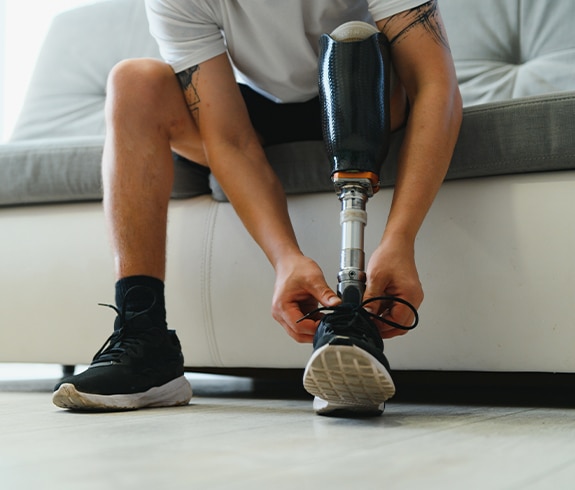
What is the definition of a traumatic amputation?
According to Johns Hopkins Medicine, “amputation is the loss or removal of a body part such as a finger, toe, hand, foot, arm, or leg.” For many victims, a traumatic amputation is life-changing. The loss of all or part of a limb or body part can affect your ability to function, work, be independent, and enjoy social connections. Complications may include phantom pain, the need for new prosthetic devices, and difficulties managing the psychological trauma of an amputation.

What types of accidents cause the loss of a limb in Huntsville, Alabama?
Martin & Helms handles the many different types of accidents that can cause traumatic amputations, including the following:
- Car accidents
- Truck accidents
- Motorcycle accidents
- Pedestrian accidents
- Bicycle accidents
- Construction accidents
- Slip and fall accidents
- Dram shop/Liquor liability
- Product defects
- Rideshare accidents
- Accidents that cause burns
- Electrical accidents
What types of medical care do amputees need?
Johns Hopkins Medicine states that the surgical team (often emergency medicine doctors, orthopedic surgeons, and plastic surgeons) will first prioritize saving your life. They will work to “preserve as much of the person’s original body as possible, while removing all injured or diseased tissue that could affect the patient’s health, safety, or comfort.” The surgical team will review the surgery’s impact on your mobility, sensation, and appearance.
Your surgeons will also focus on helping prepare your body for the use of a prosthesis (if possible). A prosthesis helps you regain bodily function, movement, and independence. A prosthesis can also help you emotionally by showing others that you can function and by helping to give you confidence.
The different types of amputation procedures include:
- Standard amputation. In this procedure:
The surgeons remove the limb, anchor muscles to the cut end of the bone, and cover it with skin. If the plan is to provide the patient with an artificial (prosthetic) leg, the terminal limb needs to be sufficiently padded with the patient’s soft tissue so that the prosthetic is comfortable and can bear weight without causing pain, infection, and tissue breakdown.
- Osseointegration (OI). This procedure involves removing your body part and inserting “a steel implant into the stump of the leftover bone,” so that a prosthetic can be attached to that implanted piece. This procedure is often used for leg amputations to help the leg and hip absorb weight.
- This type of amputation procedure is generally used when amputations are necessary due to diseases like cancer.
You must also keep the post-amputation stump bandaged, clean, and dry until it’s time to remove the stitches (sutures).
What challenges do amputees face?
Prosthetic devices
Your medical providers will help to design and create prosthetic devices for your arm, leg, hand, foot, or other body parts. They’ll work to ensure your prosthetic device fits and help you use your device for as many activities as possible.
Physical and occupational therapists should also help develop therapies that can help with movement, muscle strength, and other exercises and resources to help your function.
Phantom pain
Amputees often need help managing phantom pain, which makes victims feel pain in the part of the body that has been removed through continuing nerve sensations and other causes.
Johns Hopkins states that the cause could be that:
After amputation, the remaining nerve connections in the spinal cord and brain “remember” the body part, and can cause a compelling sensation that it is still there (phantom limb syndrome) or severe pain (phantom pain syndrome). These symptoms can be very distressing.
During the initial or a subsequent surgery, surgeons may be able to take steps “to address the nerves that carry sensations back to the brain that affect pain and phantom sensations,” which may help amputees better cope with phantom pain.
Risk of falling
Accident victims who lose the use of a foot or leg have an increased risk of falling. In addition to using a prosthesis, fall prevention strategies include placing a wheelchair or walker near a victim’s bed to remind them that their foot/leg is missing and they will need help to stand and walk. Certain exercises can also help victims adapt to the dangers of falling.
Psychological trauma
Many traumatic amputation victims also require psychological counseling to help with their loss of confidence and self-esteem, and their anxiety, depression, and/or post-traumatic stress disorder (PTSD).
At Martin & Helms, we can provide you with resources to help you connect with other amputees, such as the Amputee Coalition, and with other resources to help you function.
What is the value of my traumatic amputation claim in Huntsville?
At Martin & Helms, we work with your doctors to understand whether you can use prosthetic devices, what complications may arise due to your loss of limb, your physical limitations, your psychological trauma, and all your nonmedical needs. Our Huntsville traumatic amputation lawyers demand compensation for your damages so far and the damages you will have for the rest of your life. These damages include:
- Your medical bills of every nature, including the cost of multiple prosthetic devices
- Your physical pain and emotional suffering
- All the income and benefits you lose because you cannot work
- Your scarring and disfigurement
- Any property damage
- The loss of bodily function
- The inability to enjoy life’s pleasures
- The loss of consortium (how the injury affects your relationship with your spouse or partner)
We work to show that you were not at fault, since any liability on your part will prevent your right to recover in Alabama.
Do you have a Huntsville traumatic amputation injury lawyer near me?
Yes. We can meet clients at our Huntsville office located at 2317 Market Place SW, Suite A. Our personal injury lawyers also discuss cases by phone and through online video platforms like Zoom and FaceTime. If your amputation injuries prevent you from coming to one of our offices, we can make arrangements to meet you away from our offices.
Our lawyers are here to answer your questions and explain how the claims process works.
Contact our Huntsville loss of limb lawyers now
At Martin & Helms, we understand how upsetting it is to physically and emotionally live with the loss of a limb. We’re prepared to help you get through this difficult time and fight for your future. Please call us or fill out our contact form to schedule a free initial consultation. We represent clients in Huntsville, Decatur, Madison, Harvest, Hazel Green, Meridianville, Athens, and throughout North Alabama and the Tennessee Valley. We handle traumatic amputation cases on a contingency fee basis.